

“Just sign here, it’s only a formality.” It is not. It is a big promise with your money.
AHL AarthDisha | A Financial Awareness Initiative by Arnold Holdings Limited
Mahesh signed as guarantor for his close friend’s business loan of ₹8 lakh. His friend told him, “You won’t have to pay anything.” Three years later the business slowed down and the EMIs stopped. The lender’s notice came to Mahesh’s house. When Mahesh applied for his own home loan, it got stuck because the unpaid loan was now showing on his credit report too.
In our families and friendships, saying no to signing feels rude. So many people sign without reading anything. This blog explains what that signature really means so that you can decide properly.
What you are really agreeing to
- You have to pay the full amount. As per Section 128 of the Indian Contract Act a guarantor is liable as much as the borrower. The lender can ask you to pay the full dues including interest and charges.
- The lender can come to you directly. It does not have to first chase the borrower.
- It shows on your credit report. The loan you guaranteed, and any default on it, can lower your score and your chance of getting a loan.
- A co-applicant is also a borrower. In joint loans you are equally responsible for every EMI.
- You can’t just walk out. A guarantee usually stays till the loan is fully paid or till the lender releases you in writing.
WHAT IT REALLY COSTS YOU: If you guarantee an ₹8 lakh loan at 14% for 5 years, you are standing behind an EMI of about ₹18,600 a month and a total repayment of about ₹11.2 lakh. Ask yourself honestly, could my family pay this if needed?
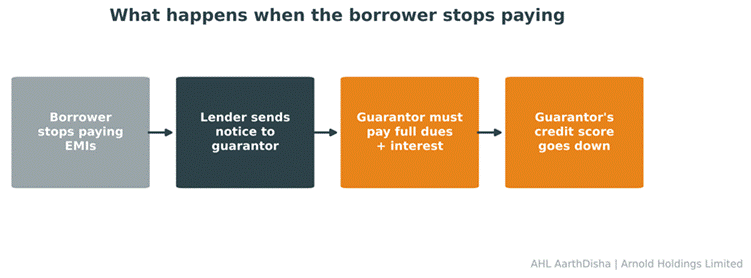
when a borrower stops paying, the guarantor must pay and their credit score goes down
Your rights as a guarantor
- You can ask for a copy of the loan agreement, the guarantee you signed and the Key Fact Statement of the loan.
- You can ask the lender for the loan account status anytime.
- If you end up paying the borrower’s dues, the law lets you recover that money from the borrower.
- If the loan terms are changed without your consent, you may be freed from the guarantee. Take advice from a lawyer if this happens.
AarthDisha guide: before you sign
- Read every page, including the guaranteed deed. If someone says “no need to read”, that is exactly why you should read.
- Ask the borrower how they will repay. Where will the EMI come from every month? Do they have savings for emergencies?
- Guarantee only what your family can repay. If you can’t, say no politely. “I can’t take a loan I wouldn’t be able to pay myself.”
- Ask for monthly updates. Ask the borrower to share the EMI receipt or loan statement every month.
- Act at the first missed EMI. Talk to the borrower and the lender right away. Fixing it early is much easier.
- Take a written release once the loan is closed and check your credit report to make sure it shows closed
AHL AARTHDISHA TIP: Helping a friend is good. But signing without reading is not help, it puts two families at risk instead of one. Saying “let’s look at this together first” protects your friendship too. Smart Bano, Aage Badho.