
Paying only the minimum amount feels safe. In reality it is one of the costliest habits you can have.
AHL AarthDisha | A Financial Awareness Initiative by Arnold Holdings Limited
Rohit is 27. He spent ₹50,000 on his credit card for a new phone and a birthday gift for his sister. His bill said Total Due ₹50,000 and Minimum Due ₹2,500. He paid ₹2,500 and thought everything was fine. He did the same every month. After two years he had already paid more than ₹55,000 and he still owed over ₹40,000.
Many people are in the same position. India had about 12.4 crore credit cards in August 2026. Unpaid card dues were close to ₹2.95 lakh crore by March 2025. A credit card is useful. But if you use it the wrong way it becomes a very expensive loan.
How the minimum due trap works
- Very high interest. Card interest is usually around 3 to 3.75% every month. That is 36 to 46% in a year.
- You lose the free credit period. If you pay even a little less than the total due, interest is charged on the whole purchase from the day you bought it.
- New spends also get charged. While old dues are pending, new purchases start getting interest from day one.
- Late fee and GST. Miss the due date and you pay a late fee. On top of that there is 18% GST on interest and fees.
- Your payment goes mostly to interest. Most of the minimum amount covers interest and charges. Very little of it reduces your actual dues
WHAT IT REALLY COSTS YOU: You owe ₹50,000 at 3.6% a month. If you pay only 5% as minimum every month, it will take about 16 years to clear, and you will pay around ₹1.58 lakh. If you pay a fixed ₹5,000 every month, it gets cleared in 13 months and you pay about ₹63,000. Same loan, but a difference of ₹95,000.
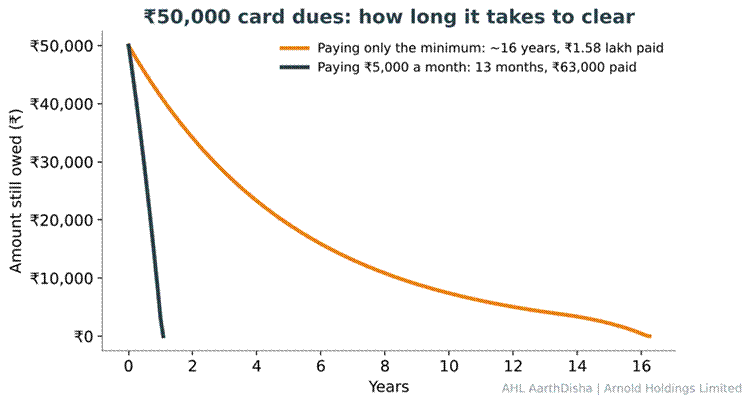
₹50,000 credit card dues take about 16 years to clear with minimum payments, versus 13 months with ₹5,000 a month
Your rights
- As per RBI rules a bank needs your clear consent before it issues a card, activates it or raises your limit.
- You can ask the bank to close your card. Once your dues are paid the bank must act on your written request.
- Your monthly bill must clearly show the total due, minimum due, interest rate and due date.
- If the bank does not solve your complaint in 30 days, you can complain to the RBI Ombudsman at cms.rbi.org.in or call 14448. It is free.
AarthDisha guide: how to use a card safely
- Always pay the full amount. Look at the minimum due as a warning, not as a target. Set auto-debit for the full bill.
- Spend only what you already have in the bank. A card is a way to pay. It is not extra money.
- Use less than 30% of your limit. This keeps your credit score and your budget healthy.
- Already have dues? Stop using the card till they are cleared. Pay a fixed amount every month that is much more than the minimum.
- Shift costly card dues to a cheaper loan. A personal loan at 12 to 16% from a proper lender is much cheaper than 40%. Clear the card with it and don’t run it up again.
- Never take cash from a credit card. Interest starts the same day and there is a withdrawal fee too.
AHL AARTHDISHA TIP: Before every swipe, ask yourself one thing. If I had to pay cash for this today, would I still buy it? If the answer is no, then the card is not the answer either. Smart Bano, Aage Badho.