
It takes one tap to buy. But many young people find their salary gone before the month ends.
AHL AarthDisha | A Financial Awareness Initiative by Arnold Holdings Limited
Sneha is 23. She bought earphones using Pay Later on one app, a jacket on another app and a phone on “No-Cost EMI” during the festival sale. Every instalment looked small. ₹600 for one, ₹1,100 for another and ₹2,400 for the phone. By December, seven different EMIs were going out of her account, and her salary was over by the 18th of every month.
Today Pay Later and no-cost EMI are offered on almost every shopping app, more so during festivals. A Deputy Governor of RBI has said that such schemes push young people to spend now and save less. Whatever name it has, remember one thing. Each of these is a loan.
What “no-cost” actually means
- Interest is still there. In most no-cost EMIs the seller gives a discount equal to the interest and the lender takes that interest. So, you often miss the cash discount you would get if you paid in one go.
- Processing fee and GST are extra. A fee of ₹199 to ₹999 plus 18% GST is very common.
- Small EMIs hide the big total. Five EMIs of ₹800 don’t feel like ₹4,000 a month. But they are.
- Late fees are high. If you miss a Pay Later due date, late fee and interest add up quickly.
- It shows on your credit report. These loans are reported to credit bureaus. One missed payment on a ₹1,500 purchase can cause problems when you apply for a home loan later
WHAT IT REALLY COSTS YOU: A phone costs ₹30,000. If you pay in one go, the store gives ₹3,000 off and you pay ₹27,000. If you take no-cost EMI, you lose that discount, pay a ₹499 fee plus GST and pay ₹30,000 over 6 months. That is about ₹30,600 in total, or roughly ₹3,600 more.
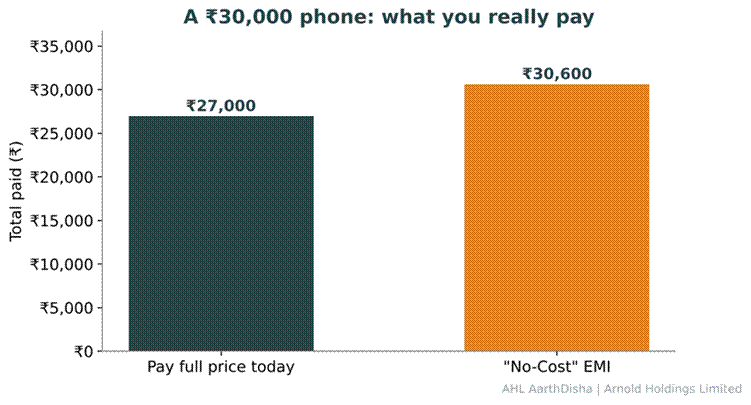
a ₹30,000 phone costs ₹27,000 if paid upfront versus about ₹30,600 on no-cost EMI
Your rights
- Every such loan must come from a bank or NBFC registered with RBI. The money must move directly between you and that lender.
- Before you accept, you must get a Key Fact Statement (KFS) that shows the real yearly cost of the loan.
- You can ask the app who the actual lender is. If they can’t tell you, don’t take the loan.
AarthDisha guide: shop smart
- Count all your EMIs. Write down every Pay Later and EMI payment in one place. If they add up to more than 30% of your salary, stop.
- Ask the cash price first. Before choosing no-cost EMI, ask how much you would pay today. Choose whichever is lower.
- Keep only one Pay Later account. Close the rest. More accounts mean more temptation and more dates to remember.
- Never use Pay Later for daily needs. If groceries, food orders and recharges go on credit your salary is spent before it even comes.
- Save first, then buy. Put aside the EMI amount for 3 to 6 months before buying. If you can save it, you can afford it, and you also get the cash discount.
AHL AARTHDISHA TIP: Words like zero, free and no-cost at checkout are for marketing. The only number that matters are how much you pay in total. Smart Bano, Aage Badho.